DESIGN GUIDES · Energy & comfort
Thermal comfort: why a room feels comfortable
Comfort depends on more than the reading on the thermostat. Surface temperatures, air movement, humidity and the way a room is used all contribute.
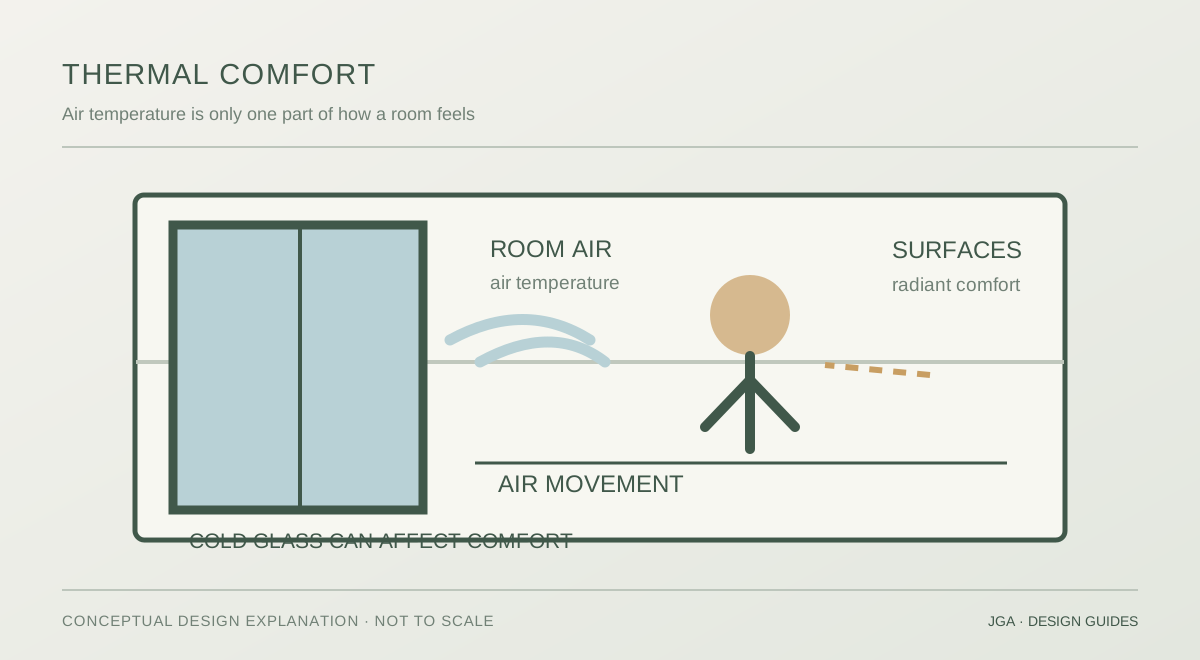
01 / NOT JUST THE AIR
A cold window can make a warm room feel chilly.
Your body exchanges radiant heat with the surfaces around it. A large cold pane of glass or uninsulated wall can feel uncomfortable even when the room air is heated. Whole-window performance and warm interior surfaces matter.
Most of us describe a room by its air temperature, but comfort is more complicated. On a cold night, standing beside a large single-glazed window can feel chilly even if the thermostat says the room is warm. Your body loses heat towards the cold glass. An uninsulated floor can make feet cold for similar reasons. Better glazing and insulation help by keeping surrounding surfaces at more comfortable temperatures, rather than simply asking the heater to work harder.
02 / AIR MOVEMENT
A breeze is welcome in summer and a draught is unwelcome in winter.
Movement of air across the skin can improve summer comfort. In winter, accidental air leakage at doors and junctions can make spaces uncomfortable even where the heating system is working.
A breeze across your skin helps you feel cooler on a hot day because it supports evaporation. That same movement is unpleasant in winter if it comes from an accidental gap beneath a door. We want to make air movement something people can control. Opening windows on different sides of a room may help in suitable weather, while sealing unwanted cracks helps preserve warmth when the house is closed. A ceiling fan can be useful without needing to lower the air temperature as much.
03 / HUMIDITY AND MOISTURE
Comfort includes how the building manages moisture.
High humidity can make warm weather feel more oppressive. Persistent condensation can also damage finishes and building elements. Ventilation, vapour management and thermal detailing must be considered together.
Humidity changes how comfortable a room feels. Warm, damp air can feel heavy, while moisture from showers or cooking can collect on cold surfaces. A house needs ways for that moisture to leave safely. This may include suitable window opening, extract fans and well-designed ventilation. The goal is not to make the home completely airtight and never open it. It is to avoid uncontrolled leakage while providing the fresh air that occupants need.
04 / THE WAY WE LIVE
Different rooms have different comfort needs.
A bedroom at night, a sunny kitchen and a home office do not all need the same temperature or air movement. Design and zoning should respond to likely occupancy rather than assuming every space is used equally.
Comfort also depends on what we are doing. A bedroom with someone sleeping under a quilt may be comfortable at a different temperature from a study where someone is sitting still at a desk. Children, older people and others may have different needs. We consider where occupants spend time, where they sit near windows and when rooms are used. A bright afternoon living room may need shade, while a bedroom may need protection from heat that lingers into the night.
05 / DESIGN CHECK
A star rating is a modelling tool, not an individual comfort guarantee.
NatHERS provides a consistent estimate of heating and cooling demand. Actual comfort also depends on installation quality, operation, weather and occupant behaviour.
Energy-rating software uses standard conditions so different designs can be compared fairly. It cannot know exactly how every future occupant will dress, open windows or run the heating. We therefore assess comfort room by room as well as looking at the overall rating. We check for cold surfaces, summer sun on beds, draughty entry points and rooms likely to trap heat. These practical questions can improve a home even when its star rating already looks satisfactory.
LOCAL APPLICATION
Canberra and New South Wales.
Canberra’s cold nights and large day-to-night changes make warm surfaces and reduced draughts especially important. Humid NSW coastal sites may need particular attention to summer airflow and moisture; alpine NSW sites have stronger winter heat-retention needs.
In Canberra, cold windows and floors can be a major comfort issue in winter, especially at night. In coastal NSW, humidity and warm nights can make summer comfort harder. Inland NSW can have hot days followed by substantial cooling after sunset. Good comfort design should respond to those differences rather than using the same package for every postcode.
Adapted in original wording and illustrations from principles discussed in Sustainability Victoria’s Energy Smart Housing Manual (2018), and the Australian Government’s Your Home passive design guides. Victorian six-star rules in the older manual are not current ACT or NSW standards. Regulatory information checked against ACT Planning and NSW Government.