DESIGN GUIDES · Construction & materials
Thermal mass: storing and releasing heat
Concrete, brick and stone can absorb and release heat. Whether they improve comfort depends on sunlight, insulation, ventilation and climate.
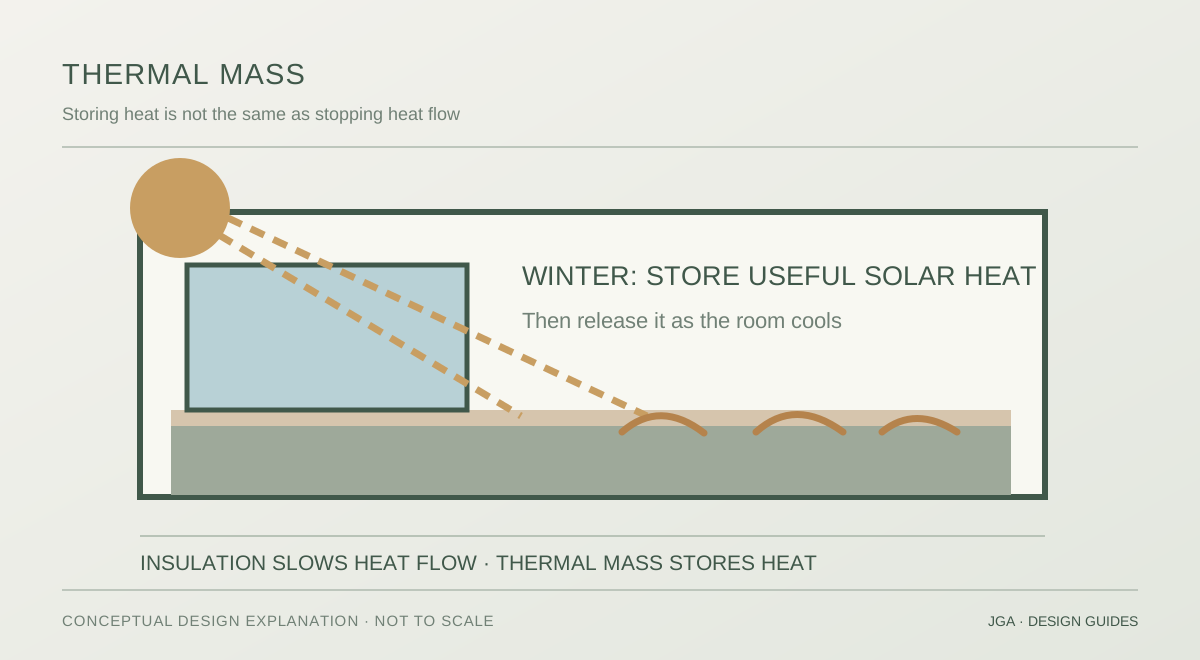
01 / WHAT MASS DOES
Thermal mass stores energy, while insulation slows its movement.
A concrete floor exposed to winter sunlight can absorb heat during the day and release it later. A heavyweight wall is not automatically well insulated, and a masonry wall outside the insulated building envelope may provide little benefit inside.
Think about a thick concrete floor left in the sun. It takes time to warm up, but once warm it also takes time to cool down. That is thermal mass: the ability of a material to hold heat and release it later. Insulation has a different job. It slows heat travelling between inside and outside. A heavy brick wall is not automatically a good insulated wall. To benefit occupants, the mass usually needs to be on the inside of the insulation where it can exchange heat with the room.
02 / WINTER RESPONSE
Useful solar access makes internal thermal mass work harder.
Mass works best where it can receive useful solar gains or controlled heat. On shaded sites it may slow the initial warm-up of a room without giving much benefit later.
On a sunny winter day, sunlight through north-facing windows may warm an exposed concrete slab or internal masonry wall. After the sun sets, the stored heat can be released gradually. This can help keep the room comfortable into the evening. However, if the same room receives little sunlight, the heavy materials may remain cold and take longer to warm with a heater. Thermal mass is not free heating by itself; it needs a useful source of warmth and a good building envelope to hold onto it.
03 / SUMMER RESPONSE
Unwanted stored heat can become a problem at night.
Correct shading limits heat gain during the day. When outside air cools, ventilation can help release heat stored in the structure. During long hot periods with warm nights, stored heat may reduce overnight comfort.
In summer, internal mass can soak up some of the warmth during the day and delay a rise in room temperature. That is helpful when the house is shaded and cooler night air can remove the stored heat. It may be less helpful during a long run of hot nights when the building never cools down. If direct summer sun pours onto the slab, the mass may store unwanted heat and release it after bedtime. Shading and a ventilation strategy are therefore essential partners.
04 / LIGHTWEIGHT ALTERNATIVES
A lightweight home can work well too.
An appropriately insulated lightweight home can respond quickly to heating and cooling. Lightweight and heavyweight construction should be compared as complete systems rather than by material alone.
A well-insulated lightweight room can heat or cool quickly. That may suit a home used intermittently or a room that is only occupied for short periods. A high-mass room generally changes temperature more slowly. Neither is automatically superior. If we compare two houses, we should check their orientation, window area, insulation, shading and how they are occupied before deciding that the heavier one will always use less energy.
05 / DESIGN CHECK
Match mass to climate, glazing and occupancy.
Location, day/night temperature range, insulation position, shading, window area, ventilation opportunities and the way rooms are used all influence the right amount of mass.
We look at what mass the design already has, such as a concrete slab, and whether it will actually be exposed to the room. Thick carpet or insulation above the slab may reduce its usefulness as an internal heat store. We then check winter sun, summer shade and whether cooler air can move through the house at night. The amount and placement of mass should be judged as part of the entire design.
LOCAL APPLICATION
Canberra and New South Wales.
For Canberra and the Southern Tablelands, winter solar access and strong insulation can make carefully placed internal thermal mass useful. Coastal NSW may have smaller day/night differences, while alpine and inland locations differ again. Model the actual project before assuming more mass is better.
Canberra's sunny winter days and large day-to-night temperature changes can create good opportunities for internal thermal mass when the home is well insulated. Some inland NSW areas have similar opportunities. In humid coastal NSW, nights may stay warmer, reducing the benefit of using night air to cool the mass. Cold alpine locations have different heating priorities. We should not specify extra concrete simply because a product brochure describes it as energy efficient.
Adapted in original wording and illustrations from principles discussed in Sustainability Victoria’s Energy Smart Housing Manual (2018), and the Australian Government’s Your Home passive design guides. Victorian six-star rules in the older manual are not current ACT or NSW standards. Regulatory information checked against ACT Planning and NSW Government. Further reading reviewed for this guide includes Thermal Mass Benefits for Housing (Cement Concrete & Aggregates Australia, 2010), Sustainability Victoria’s Thermal Mass fact sheet, and the ResourceSmart technical information sheet on thermal mass.