DESIGN GUIDES · Approvals & ratings
BASIX: thermal, energy and water
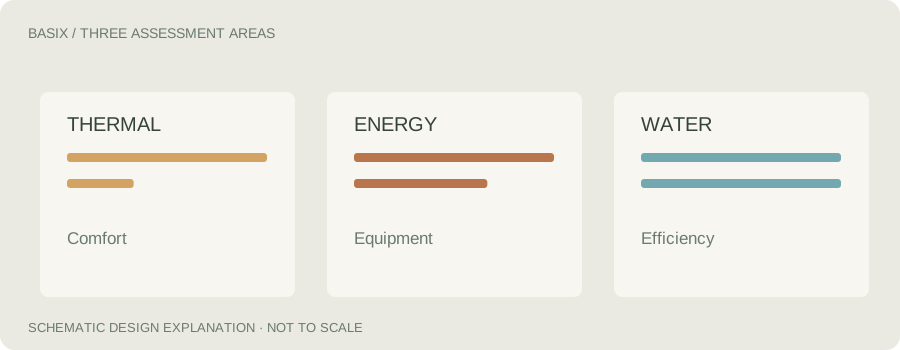
In New South Wales, sustainability requirements form part of the residential approval process. BASIX brings thermal comfort, energy use and water efficiency into one assessment.
01 / NSW RESIDENTIAL SUSTAINABILITY
BASIX is part of the development approval process.
BASIX stands for Building Sustainability Index. It is a NSW assessment tool designed to improve the sustainability of residential development by assessing the proposed design and its expected performance.
It generally applies to new residential dwellings, alterations and additions of $50,000 or more, and pools or spas of 40,000 litres or more, subject to the project type and current rules.
An approved BASIX certificate sets out commitments that become part of the design and construction documentation. It is not simply an optional energy rating.
For many NSW residential projects, a BASIX certificate forms part of the approval documents. It is not simply a sticker that says the house is sustainable. The certificate records design choices that the project is committing to deliver, such as window performance, insulation, water-saving fittings and equipment. Those commitments need to match the drawings, specifications and the house that is built. A change during construction can mean the assessment needs to be checked or updated.
02 / AREA 01
How well the building keeps occupants comfortable.
The thermal performance part looks at how the building envelope responds to its local climate. Orientation, glazing, shading, roof and wall construction and insulation all influence the predicted need for heating and cooling.
For suitable projects, the assessment can use an approved simplified DIY method or simulation with NatHERS-accredited software. Complex designs often benefit from detailed modelling.
A seven-star NatHERS result is not a complete BASIX certificate. Thermal performance is only one component.
The thermal part asks how much extra heating or cooling the design is likely to need. Orientation, glass, shading, roof, walls and floors all affect the result. Depending on the development and assessment pathway, the calculation may use a detailed NatHERS simulation. In a cold NSW town, winter heat loss may be the main difficulty. In a warmer coastal area, summer cooling may be more important. The thermal assessment is about the building itself, rather than the efficiency of the heater selected later.
03 / AREA 02
How much energy the home is expected to use.
The energy component assesses the proposed systems and their expected demand. Heating and cooling equipment, water heating, ventilation, lighting and other relevant systems are considered under the BASIX methodology.
Onsite renewable energy can contribute where recognised by the assessment. System efficiency and the predicted heating and cooling load are connected: a better envelope can reduce the energy required from appliances.
The commitments need to match the equipment and systems ultimately specified for the home.
The energy section looks beyond the building shell. It considers systems such as hot water, heating and cooling, lighting and ventilation, together with other relevant equipment. For example, a well-insulated home may require less heating, but the type of hot-water system still affects its broader energy result. BASIX uses the project details and applicable standards to assess the design. A high thermal rating does not automatically mean every energy-use requirement is met.
04 / AREA 03
How the project is expected to use water.
The water component considers the water efficiency of fixtures and fittings, landscaping and where relevant, alternative water sources such as rainwater tanks.
Different project types and locations can have different targets or assessment conditions. A proposed rainwater system needs to match the actual roof catchment, intended connections and the design documentation.
A BASIX target is not simply a promise to install a water tank. The overall design and the commitments must be assessed together.
The water section considers the expected use of drinking water. Efficient taps, showers and toilets are part of the picture. Depending on the project, water tanks and how rainwater will be used may also matter. It is worth thinking about these systems early: a tank may need space, appropriate plumbing connections and a practical way to use the stored water. The BASIX commitments should be realistic to build and maintain, not just choices made to obtain a score.
05 / THE COMPLETE CERTIFICATE
BASIX also records materials and embodied emissions.
The NSW BASIX tool includes a materials index that estimates embodied emissions associated with selected building materials. It sits alongside the three principal water, energy and thermal performance assessment areas.
Once the required assessment is complete, a BASIX certificate is generated for the development application or complying development certificate process.
The certificate lists sustainability commitments. If specifications change during design or construction, the assessment and certificate may need to be reviewed or updated.
The materials index records estimates of the emissions associated with producing the main materials used in the home. This is different from the electricity and water the household will use after moving in. A design may use more material to improve thermal performance, so the relationship is not always simple. NSW currently requires the embodied-emissions information to be calculated and reported for applicable projects; the materials index is not another numerical pass threshold in the same way as the main water, energy and thermal standards.
06 / RULES AND TRANSITIONS
Use the right rules for the project.
NCC 2025 has been published, but NSW adopts it from 1 May 2027. Until then, NCC 2022 remains the relevant NCC edition in NSW, with its applicable amendments and NSW-specific requirements.
BASIX continues to operate as a NSW sustainability approval process. The NCC edition, BASIX requirements and building-specific exceptions should be confirmed for the project before documentation is finalised.
At Jefferson Godfrey Architects we consider sustainability requirements early in design, so they influence the house rather than become a late compliance surprise.
BASIX and the National Construction Code are related but different. BASIX is part of the NSW planning and approval pathway for the projects it covers. The NCC sets building requirements and has state variations. The relevant edition depends on the approval date and transitional arrangements. As at November 2026, NSW plans to adopt NCC 2025 on 1 May 2027, so a current design may need to consider which edition will apply when approval is sought. ACT projects do not use NSW BASIX.
07 / PUTTING IT TOGETHER
What we check when designing a home.
Project scope. Does BASIX apply to the new house, alteration or pool?
Thermal. Which assessment method suits the design?
Energy and water. Do the planned systems and fittings match the targets?
Certificate. Are all BASIX commitments shown consistently on the plans?
Regulatory note. NSW code adoption: NCC 2025 commences on 1 May 2027. Confirm current requirements at approval. Read the NSW BASIX guide.
The best time to prepare BASIX information is when the drawings and major product selections are still being coordinated. We check the window schedule, insulation, roof and wall constructions, hot-water system and proposed water fittings. Then we compare the assessment commitments against the design documents. If a builder proposes a different product, that needs to be checked against the commitments before it is installed.
APPLYING THE PRINCIPLES LOCALLY
Canberra and New South Wales.
NSW requirements apply across a wide range of climates, but the performance targets and appropriate design response can vary with location and building type. A project in Queanbeyan may face similar winter conditions to Canberra while following a different approval process. Projects in coastal NSW have different climate concerns again. We explain the design principles in both locations, then use the relevant state approval pathway for the actual site.
For ACT projects, BASIX does not apply. ACT projects follow their own approval and NCC pathways, and NatHERS may be used where relevant.
NSW BASIX addresses thermal performance, energy and water. Certificate commitments and applicable NCC provisions must align with the project and its approval date.
Technical references: NSW Planning Portal: BASIX, NSW Planning Portal: About BASIX, NSW BASIX thermal performance. All writing and diagrams are original JGA explanatory material. Additional background: Sustainability Victoria, Energy Smart Housing Manual (2018), adapted for ACT and NSW. The original Victorian six-star references are historical, not the current regulatory standard.